
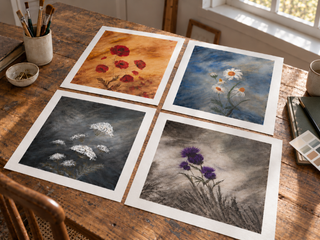
How to present your work with clarity, confidence and purpose.
An artist's portfolio is often the first introduction to their work. Whether approaching a gallery, applying for an exhibition or joining an artists' network, the way artworks are selected and presented can be just as important as the information accompanying them.
But a portfolio doesn't need to include everything an artist has created. In fact, a carefully chosen selection often communicates far more than an extensive collection of images.
Choose quality over quantity
The temptation to show as much work as possible is understandable, particularly for artists who work across different styles or materials.
However, a portfolio is not a complete archive. Its purpose is to give viewers a clear understanding of an artist's practice.
As a starting point, consider selecting eight to twelve works that represent your current artistic direction. This is not a fixed rule; exhibition organisers and open calls may have their own requirements.
Ask yourself whether each piece contributes something meaningful to the overall selection. A strong individual artwork may still be better left out if it doesn't fit the presentation.
Look for connections between works
A coherent portfolio doesn't necessarily mean every artwork must look alike.
An artist working with both painting and sculpture, for example, might explore similar themes through very different materials. Those connections can reveal an artistic identity more effectively than grouping work by medium alone.
Think about the order in which the work appears. Consider how colours, subjects, materials and ideas relate to one another.
The aim is to help viewers understand not only what you create, but also what interests you as an artist.
Give each artwork the information it deserves
Good images are essential, but they shouldn't be left without context.
Include the artwork's title, year, medium and dimensions. For photography and printmaking, edition information may also be relevant.
Sculptors may need several photographs to communicate the scale, material and different viewpoints of a piece.
Keep descriptions brief. A sentence explaining an unusual technique or the inspiration behind a series can add value, but lengthy interpretations are rarely necessary.
Allow the artwork to speak for itself.
Write about your practice in your own voice
An artist statement doesn't need complicated language to sound professional.
Explain what you create, the materials you use and the ideas that interest you. Be specific rather than relying on broad phrases about creativity, passion or self-expression.
A straightforward description of an artistic process can often be more engaging than an elaborate statement filled with abstract terminology.
The same applies to an artist biography. Mention relevant experience, exhibitions or training, but don't feel obliged to exaggerate achievements. A developing artistic practice is no less worthy of a thoughtful presentation.
Make your portfolio easy to explore
A portfolio can take several forms: a website, a PDF or a profile on an artist platform.
Whatever the format, navigation should be simple, images should display clearly and contact information should be easy to find.
It is also worth reviewing your portfolio regularly. New work may better represent your artistic direction, while older pieces can remain part of your wider archive.
A portfolio is not simply a record of what you have made. It is a considered introduction to the work you want people to discover.
Taking time to select, organise and present that work is an investment in how your artistic practice is understood.
Dizaura Artists Network supports independent visual artists in Belgium through artistic exchange, professional visibility and shared knowledge.
Discover the network at dizaura.com.